Published on: 17.3.2023
Information produced by Finnish Environment Institute
Water footprint calculator describes overall water use
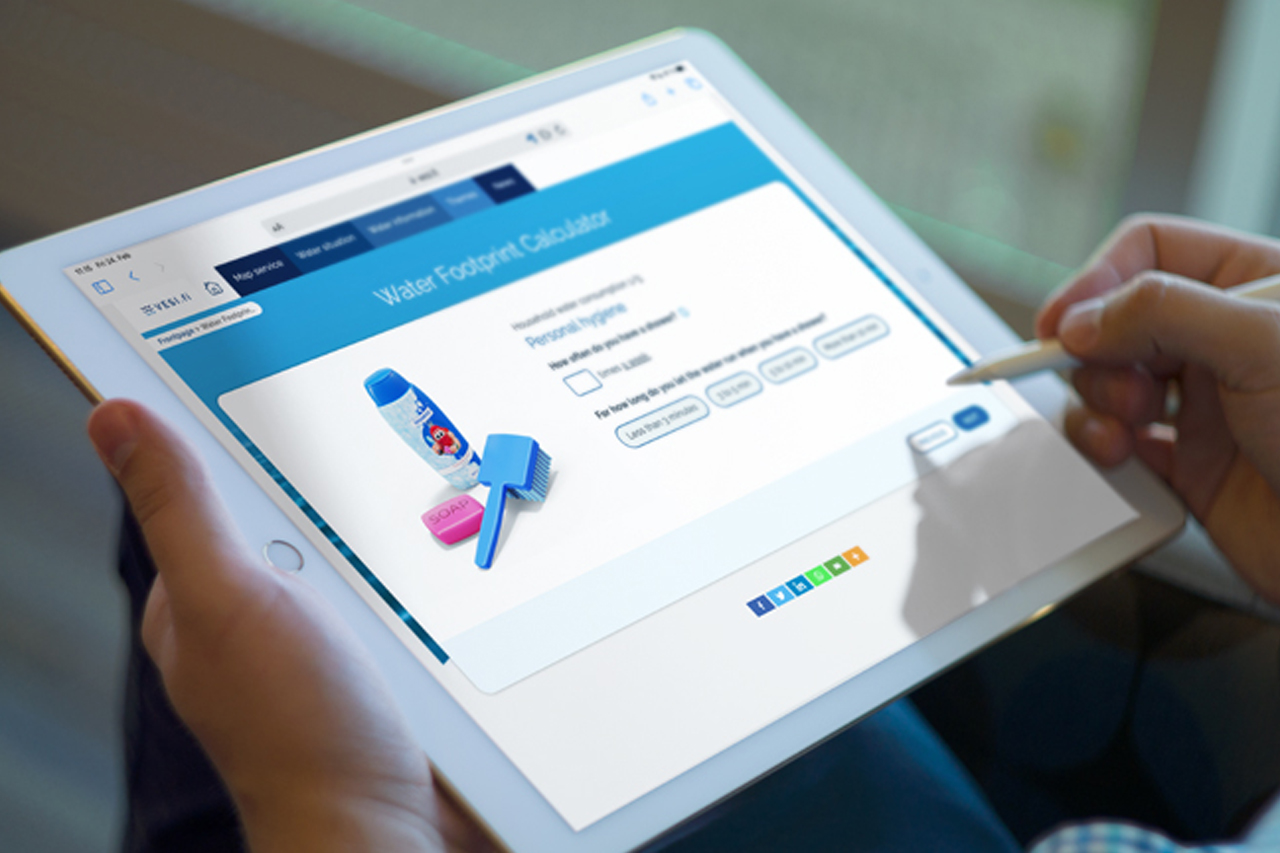
The water footprint calculator created by the Finnish Environment Institute is an interesting tool for examining your water footprint. This calculator available on the vesi.fi (waterinformation.fi) web service illustrates the levels of water consumption associated with our lifestyles. The greater the water footprint, the larger the volume of water used.
The water footprint calculator factors in all water use: the water you run from the tap and so-called virtual water. Virtual (or hidden) water refers to water used to produce commodities: raw materials, intermediate products, energy and services.
Direct water use accounts for less than five per cent of consumers’ water footprint
Direct consumption accounts for less than five per cent of the Finnish consumer’s average water footprint. The remainder is virtual water contained in the products and services we buy, whether they were produced in Finland or abroad.
“The purpose of the water footprint calculator is to make you think about your water consumption. It does not include all potential uses of water, but it will help you identify areas in which you can reduce your personal water footprint. Virtual water consumption can be reduced by recycling clothes and other goods, opting for walking and cycling, and minimising your food losses”, explains Heidi Ahkola, a researcher at the Finnish Environment Institute.
One third of Finland’s total water footprint is virtual water
A water footprint can be calculated for an individual citizen or even for an entire nation. One third of Finland’s total water footprint consists of virtual water contained in imported products. A footprint can also be calculated for a company or a whole industry as well as for products and product groups. However, the footprint of an individual product depends to a great extent on where and how it was produced, and what adverse effects its production caused to local water resources and water bodies.
Blue, grey and green water footprint
Blue water footprint refers to water taken from groundwater deposits, lakes or rivers. If the volume of water abstracted from these resources exceeds their regeneration rate, the water reserves will be depleted before long. Significantly depleted groundwater resources are a course for concern in many agricultural regions globally, and surface water resources are also overused in some regions.
Grey water footprint describes the negative effects of wastewaters discharged into the environment. The size of the grey water footprint, in other words harms caused by the influx of wastewater, depends on both local conditions and the substances contained in the wastewater.
Green water footprint refers to rainwater transpired by cultivated plants. Types of farming that depend mainly on rain or collected rainwater for irrigating the crops have a particularly large green water footprint.
Based on research evidence and a water consumption model
The calculator created by the Finnish Environment Institute can be used to examine your water use and estimate which share of your total water consumption is ascribed to direct water use and which to products and services you buy. The calculations of hidden water consumption are based on a model known as ENVIMAT. ENVIMAT is a so-called environmentally extended input-output model that describes the relationships between natural resources use, consumption and production.
Seija Rantonen, Group Manager and Project Manager at the Finnish Environment Institute, explains: “The model works out the water footprints of products, in other words how much water from different sources was used to manufacture products over their entire life cycle.”
The water footprint calculator uses detailed and accurate data on water use in Finland. Accurate calculations cannot yet be made for imported products, which is why the calculator relies on international datasets for this part.
More information about the water footprint:
Water footprint theme page
Calculate your water footprint: Water footprint calculator
Water glossary