Published on: 19.8.2025
Information produced by Finnish Environment Institute
Roadmap steers reduction of greenhouse gas emissions from water services
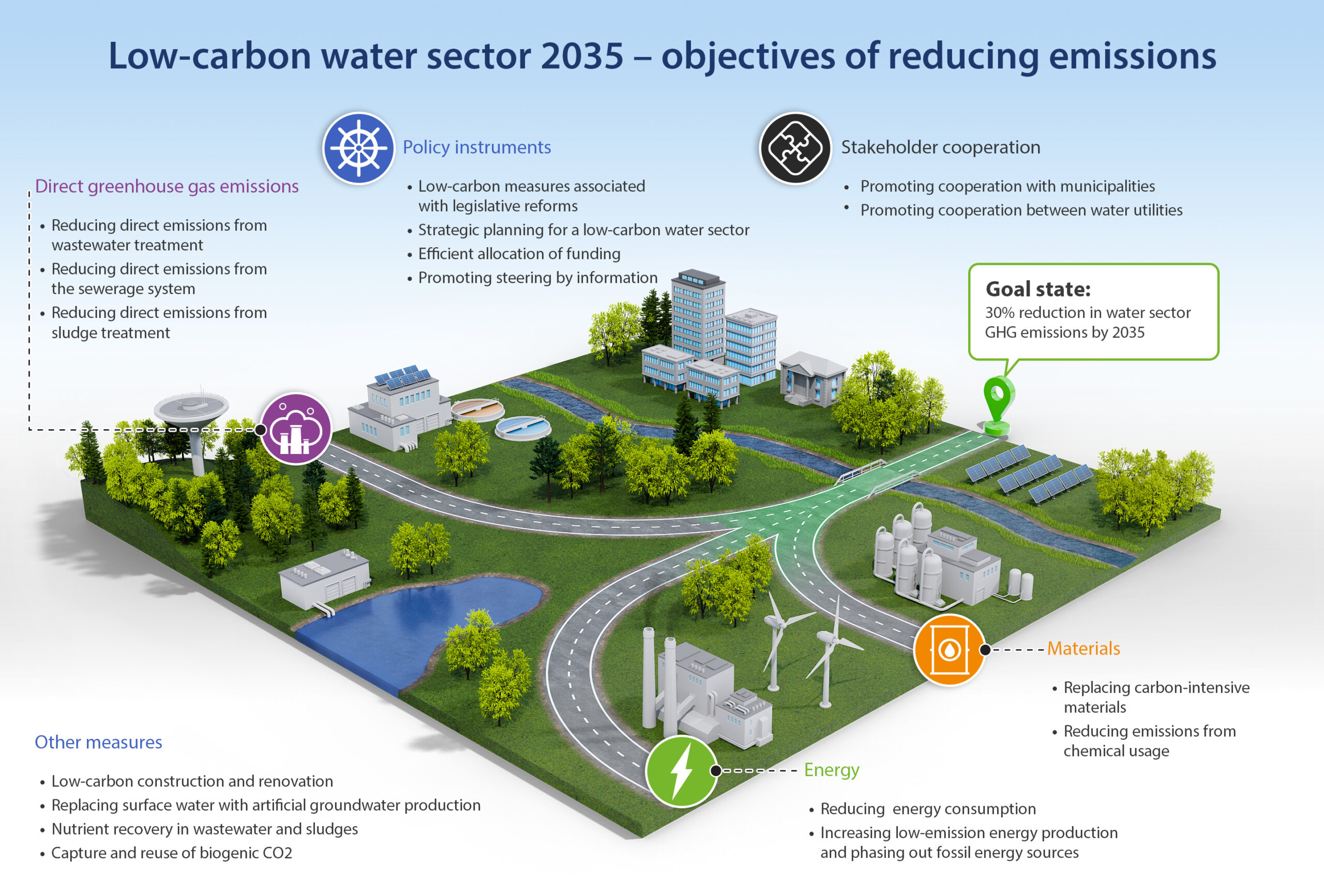
Greenhouse gas emissions from Finland’s water sector should be reduced by 30 percent by 2035. This target has been set in the recent publication “Low-carbon water sector 2035: Roadmap for reducing emissions in Finland” that also defines the means by which this ambitious goal will be achieved.
Water supply and wastewater management create greenhouse gas emissions at various stages of the process. The largest emission source is wastewater treatment releasing particularly nitrous oxide and methane, which are potent greenhouse gases. Indirect emissions from consumed energy, chemicals and materials also play a significant role.
Roadmap establishes steps towards low-carbon water services
The roadmap addresses both direct and indirect emissions. It establishes clear steps towards achieving a 30 percent reduction by 2035 and also presents cost estimates for the proposed measures.
Measures for reducing direct emission focus on wastewater services, in particular cutting down nitrous oxide emissions from wastewater treatment, which alone would cover about half of the entire emission reduction target for water services. To support these measures, better monitoring of direct emissions, especially nitrous oxide emissions, is needed.
Other measures include reducing indirect emissions from wastewater and sludge treatment as well as emissions caused by drinking water production and by sewer systems. Indirect emissions are reduced by, among other things, improving the energy efficiency of water services and phasing out fossil energy sources. These measures, together with intensified use of waste heat from treated wastewater as an energy source, especially in district heating, would enable the entire Finnish water sector to become energy positive. Furthermore, the roadmap steers towards reducing the use of chemicals and carbon-intensive materials.
In addition to actual emission reduction measures, the roadmap includes various supporting measures that promote and support emission mitigation. These include, for example, developing legislation and strategic planning as well as producing low-carbon guidelines and other information material.
Result of broad cooperation
The low-carbon roadmap for water services has been compiled at the Finnish Environment Institute, but it is based on broad cooperation. The work has involved, among others, several water utilities and other actors in the field as well as three ministries. The roadmap has thus attained broad support within the water sector, which is important because its implementation is based on voluntary actions.
The roadmap work at Finnish Environment Institute has been led by Vuokko Laukka, leading researcher in Sustainable water services group. She considers the now-published roadmap an important part of Finnish climate work and even an internationally significant achievement. In September 2025, Laukka will travel to the Nordic Wastewater Conference held in Oslo to present the Finnish low-carbon roadmap for water services.
Publication:
More information:
Vuokko Laukka, Finnish Environment Institute
forename.surname@syke.fi